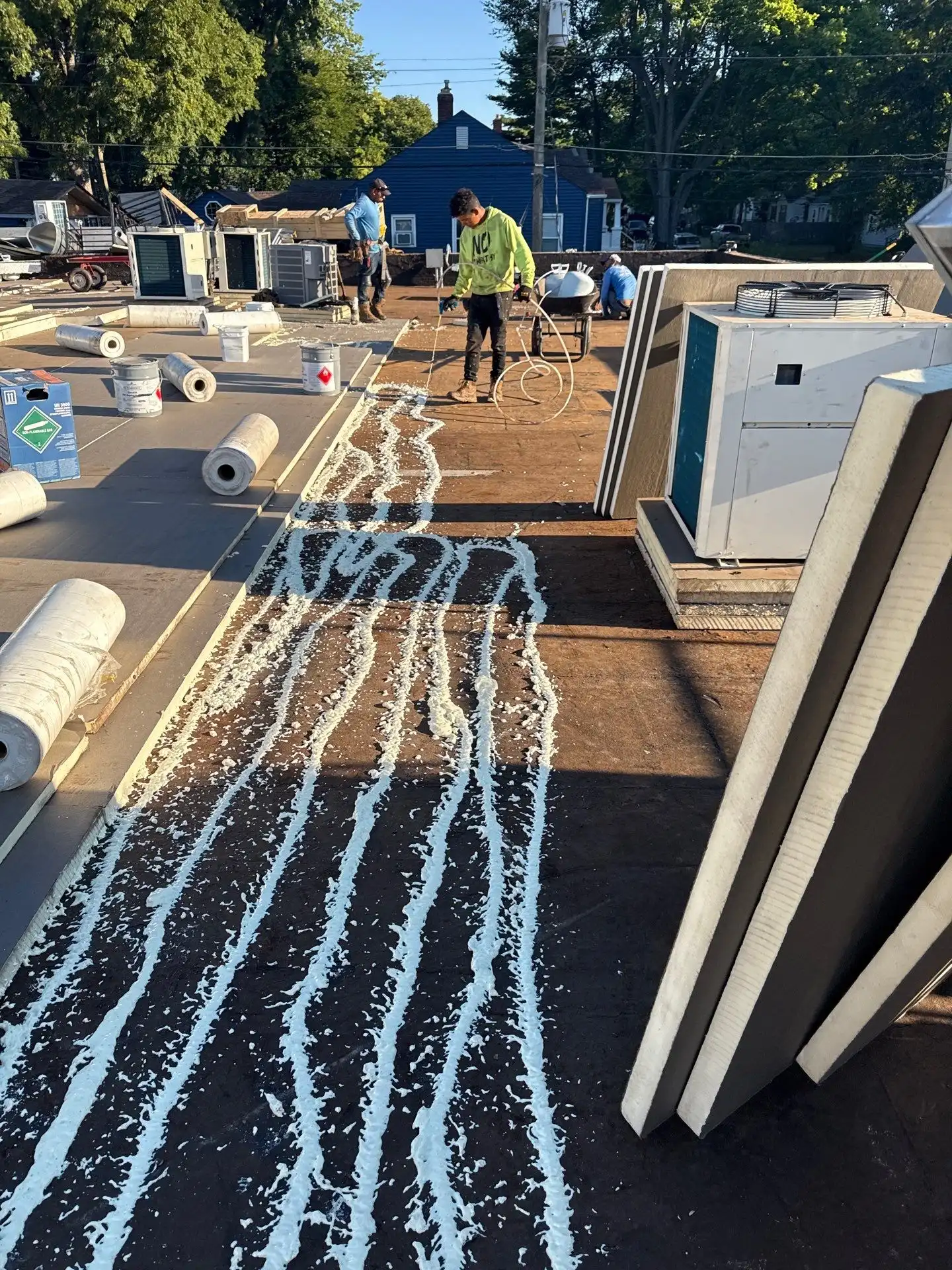
What restoration looks like on your building
One reason restoration appeals to Batesville property managers is how little it disrupts the building. The work happens almost entirely on the roof, and the tenants below usually keep operating. Understanding what each path involves makes the cost difference easier to weigh, because part of the cost is time and disruption, not just dollars on the invoice.
The restoration process, step by step
A restoration starts with cleaning the existing membrane, usually a power wash, so the coating can bond to a sound surface. Crews then reinforce the seams, repair any failed flashing, and seal penetrations, the details where roofs actually leak. Ponding areas and low spots may get extra attention, since standing water is hardest on any coating. Only after the roof is sound does the coating go on, typically in two coats sprayed or rolled to a warranted dry film thickness. The roof stays in service throughout, and a typical Batesville restoration wraps in a matter of days rather than weeks. Because there is no tear off, there is no exposed deck and no scramble to dry in before weather hits, which is a real advantage during an unpredictable Ripley County season.
What replacement looks like on your building
Replacement is a larger operation with more phases and more coordination. Crews tear off the old roof down to the deck, haul it away, and inspect the deck for rot or corrosion, repairing what they find before anything new goes down. New insulation follows, brought to current energy code, then the new membrane or metal system is installed to manufacturer specification, which is what makes the warranty valid. Edge metal, terminations, and rooftop equipment curbs are detailed last, because those details are where a new roof most often leaks if they are rushed. For an occupied Batesville building, the work is often phased section by section so operations continue, which protects your tenants but stretches the timeline compared with a coating.
What closeout should include
On either path, the closeout package is part of what you are paying for and worth checking. A proper restoration or replacement ends with photo documentation of the work, the warranty registered in the building owner name, and a written record of what was done. That paper trail matters later, for the next inspection, for a future sale, and for any warranty claim. A coating without a registered warranty and a replacement without documented details are both worth less than they look, so confirm the closeout up front rather than after the crews leave.
Scheduling around your operations
The disruption difference is one of the most underweighted parts of the decision. A coating can often be scheduled with little more than a heads up to tenants. A replacement needs real coordination: staging areas, crane time, noise during business hours, and section by section phasing if the building cannot be exposed all at once. For a Batesville building that runs seven days or houses sensitive operations, that coordination can add cost in the form of weekend work or extended timelines. Folding the operational impact into the comparison, alongside the installed price, is what makes it an honest one.
Choosing based on what your roof needs done
How long each path keeps crews on your roof
Timeline is part of the cost, and the two paths sit far apart on it. A typical Batesville restoration is measured in days, often a matter of cleaning, repairing the details, and applying the coats over a short, weather dependent window, with the building in normal operation the whole time. A full replacement is measured in weeks for most commercial roofs, longer on large or complex buildings, and longer still when the work has to be phased section by section so an occupied building keeps running. That phasing protects your tenants and your operations, which is the right call, but it stretches the calendar and concentrates more disruption into the project than a coating ever does. When you weigh the two, the schedule and the operational impact belong in the comparison next to the price, because for some buildings the difference between days and weeks of rooftop work is itself a real cost.
The right path is the one whose process matches your roof's actual condition. A sound roof needs the restoration process, and paying for the full replacement process wastes the difference. A failing roof needs the replacement process, and the restoration process leaves the real problems in place under a fresh surface. The deciding information is what the inspection finds under the membrane. Batesville Commercial Roofing inspects Batesville commercial roofs free, explains which process your roof needs and why, and writes the scope so there are no surprises mid project. Call (765) 676-3491 to schedule yours.
Why certified installation protects the warranty
On the replacement side especially, who installs the roof is not a detail, it is what makes the warranty real. Manufacturer system warranties are valid only when the roof is installed to specification by crews the manufacturer recognizes, and a system installed off spec can leave you with a roof that looks new but carries coverage that will not hold up when you need it. The same logic applies to a coating, where the warranty assumes the right prep, the right number of coats, and the rated film thickness. Paying for certified, in spec installation is not paying extra for the same roof. It is paying for the coverage and the service life that the roof is supposed to come with, which is the entire point of choosing the right path in the first place. Batesville Commercial Roofing installs Batesville systems to that standard so the warranty behind your roof is one you can actually rely on.
What to confirm before either project starts
Whichever path your roof needs, a few questions up front separate a project that goes smoothly from one that surprises you, and they apply to both restoration and replacement. Confirm what the warranty actually covers and whose name it is registered in, because a coating without a registered warranty and a replacement without a manufacturer warranty in the owner name are both worth less than they appear. Confirm how the crew protects the building during the work, how they handle weather, and what the plan is if the deck or substrate turns out worse than expected once they are into it. Confirm the closeout deliverables, the photos, the documentation, the warranty paperwork, in writing before the work starts rather than chasing them after. None of these are exotic requests, but asking them up front on a Batesville project is what keeps the scope honest and the price firm.